Industry Statement
In high pressure die casting, heat is not a background variable, it is the process. Molten metal injected at pressures between 1,500 and 25,000 psi behaves predictably only when the die is operating within a defined thermal window. Drift outside that window, and the part quality drifts with it.
Temperature, time, and pressure are the three governing variables of any casting operation. While pressure is machine-controlled and cycle time is scheduled, temperature is the variable most likely to change without warning and the hardest to detect without the right tooling.
Thermal balance is not just a best practice, it is a defining condition of process stability. As noted in industry research, “a critical point in any die casting process is achieving thermal balance… infrared thermal imaging enables reduced cycle times, lower scrap rates, and improved overall process reliability” (Soltec Corporation. (n.d.). Optimization of die casting processes.). This reinforces what many operations experience firsthand: when temperature is controlled, everything else becomes more predictable.
Die casting depends on controlled thermal conditions to ensure consistent part quality and tool performance. Even small temperature deviations can lead to cascading defects: porosity, cold shuts, premature die wear, and increased scrap. And yet, for many operations, temperature monitoring still relies on handheld pyrometers, spot checks, or worse, visual inspection after the part has already failed.
What you cannot measure ("see") in real time, you cannot control in real time.
Thermal imaging changes that equation and helps you to see. THE REAL COST OF THERMAL BLIND SPOTS
Die casting operators are well acquainted with the symptoms: porosity complaints from downstream, dies wearing faster than expected, scrap rates that creep up mid-run, and cycle times that stretch because cooling isn’t performing consistently. What is less visible is the root cause: uncontrolled heat.
Here is where thermal instability typically shows up in a die casting operation:
Uneven Die Temperature: Hot Spots and Cold Zones
A die does not heat uniformly. Gate areas, sharp corners, and thick-walled sections absorb and retain heat differently. Without full-surface thermal visibility, operators are managing temperature from a single point, which tells an incomplete story.
Hot spots accelerate die wear and cracking. Cold zones cause premature solidification of the metal, resulting in incomplete fill, cold shuts, and surface defects. Both conditions increase scrap and reduce die life. Both are invisible without thermal imaging.
Porosity and Incomplete Fill
Porosity in die casting is rarely random. It follows thermal patterns, locations where metal cools too quickly before fill is complete, or where trapped gas cannot escape because the die temperature is out of range. When temperature is monitored only at a single point or after the shot, the window to prevent porosity has already closed.
Full-field thermal imaging captures what is actually happening across the entire die face, cycle after cycle, giving engineers the data to correlate thermal conditions to porosity events and correct before scrap accumulates.
Cooling Line Performance and Thermal Fatigue
Cooling channels degrade over time. Scale buildup, blockage, or shifts in water flow can significantly reduce a circuit’s effectiveness and that degradation is invisible from the outside. The result is thermal drift: the die slowly runs hotter, part dimensions shift, and die life shortens.
Thermal fatigue: the network of heat-check cracks that develop on die surfaces from repeated thermal cycling and is accelerated when cooling is uneven. Monitoring die surface temperature in real time allows engineers to identify cooling degradation before it causes tool damage. This aligns with broader research into thermal behavior in die casting, where infrared imaging has been used alongside heat flux measurement to better understand cooling dynamics and process variability. Studies show that even secondary inputs like die lubricants can significantly influence heat transfer behavior when observed through thermal imaging (Science Direct Díaz, J., et al. (2008). The cooling effects of die lubricants investigated using heat flux sensors and infrared imaging. Sensors and Actuators A: Physical.). Without full-field visibility, these interactions remain largely invisible to the process engineer.
DIE SPRAY: THE MOST UNDERMONITORED VARIABLE IN THE PROCESS
Die spray is one of the most critical and most under-monitored variables in high-pressure die casting. It serves three simultaneous functions: lubricating the die surface for part release, regulating die temperature between shots, and creating the thermal environment the next cycle depends on.
When die spray is applied correctly, it establishes a consistent lubricant film that prevents soldering, reduces friction during ejection, and pulls excess heat from the die surface. When it is not applied correctly, wrong coverage, incorrect concentration, inconsistent timing, or misaligned nozzles leading to the consequences compound quickly.
What Happens When the Spray Misses
Insufficient spray coverage leaves sections of the die surface inadequately lubricated and thermally uncontrolled. In those areas, the metal is more likely to solder to the die, ejection forces increase, and die surface temperatures rise beyond their intended range. The result: surface defects, dimensional inconsistencies, and accelerated die wear.
Too much spray introduces a different problem. Excess lubricant that cannot evaporate before the next shot generates gas in the die cavity which becomes porosity in the part. The correct spray application is not a range; it is a precise process parameter that requires validation every cycle.
Die spray is a process parameter, not a maintenance step.
Without real-time verification, your process remains uncontrolled.
Thermal Imaging Validates Spray Coverage
Because die spray directly affects die surface temperature, a properly calibrated thermal imaging system provides a real-time proxy for spray performance. If a nozzle clogs, an area of the die will retain heat where it previously cooled. If spray concentration changes, the thermal response of the die surface will reflect that change before the next shot is made.
This is the difference between reacting to a defective part and preventing the defect from forming. Thermal data gives process engineers a leading indicator, not a lagging one. Thermographic analysis has been widely validated as a method for understanding die temperature distribution and improving process control. Research demonstrates that “thermography coupled with image processing offers insights into die temperature profiles for better process control” (Integrated optimization system for high pressure die casting processes. (2010). Academia.edu). In practice, this means spray performance is no longer inferred, it is directly measurable through its thermal impact.
PART EJECTION MONITORING: A RISK MOST OPERATIONS DON'T SEE COMING
In a fully automated die casting cell, the machine operates on a fixed cycle: inject, hold, open, eject, spray, close, repeat. When a part ejects cleanly, the cycle completes as designed. When it does not, (when a casting sticks in the die) the downstream consequences depend entirely on whether the machine or the operator knows it happened.
A stuck or partially ejected part is one of the more serious failure modes in die casting. If the condition is not detected before the die closes, the result is a double-shot event: the next injection of molten metal is made against a part that is still in the cavity. The consequences range from damaged tooling and deformed castings to ejector pin failure, die damage, and unplanned downtime that can last hours.
Why Parts Stick
Ejection failure is closely linked to thermal conditions. Parts that stick in the die are most often the product of insufficient draft angles, inadequate spray lubrication, or critically, a die surface temperature outside the recommended operating window. When the die runs too hot, metal is more prone to soldering; when it runs too cold, the part may not have solidified uniformly, causing it to grip uneven sections of the cavity wall.
In practice, ejector pins bend or break, loose cores fail to fully retract, or the part simply adheres due to inadequate release agent coverage. Any of these conditions can result in a retained casting that the machine has no native sensor to detect.
Thermal Imaging Detects Part Presence
A thermal imaging system mounted to monitor the die face between shots provides a reliable, non-contact method for verifying that the cavity is clear before the die closes. A retained part emits a distinctive thermal signature against the background of the die surface. This signal can be configured to trigger an alarm or stop the machine before the next cycle initiates.
This is not a theoretical capability, it is a practical application of thermal data used to protect tooling investment, prevent unplanned downtime, and eliminate the risk of catastrophic die damage from double-shot events.
A retained part is not always visible to the robot or the operator.
But it is always visible to a thermal camera.
WHAT THERMAL PROCESS INTELLIGENCE LOOKS LIKE IN PRACTICE
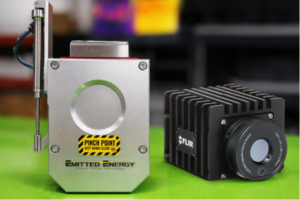
Emitted Energy designs and engineers custom thermal imaging systems for die casting operations. These are not off-the-shelf cameras mounted to a bracket. They are engineered-to-order systems that integrate with the machine cycle, monitor the specific thermal parameters that matter to the process, and deliver data that engineers can act on. Industrial thermal monitoring systems, such as FLIR A50/A70 image streaming cameras, provide continuous, real-time visibility into die temperature and process conditions without interrupting

Here is what that looks like in a die casting environment:
- Real-time die temperature distribution mapped across the full die face, not just a single measurement point
- Cycle-to-cycle thermal comparison to detect drift before it becomes a defect
- Cooling line performance validation, identify which circuits are degrading and where
- Die spray coverage verification through thermal response monitoring
- Die spray optimization for reduced cycle time and minimize spray consumption
- Part presence detection in the cavity prior to die close
- Thermal data logging for process documentation, root cause analysis, and quality validation
The result is a process that is visible, measurable, and controllable, one where engineers are making decisions from thermal data rather than downstream.

Why Emitted Energy
Emitted Energy’s team brings over 100 years of combined manufacturing floor experience. We have worked in these environments, run these processes, and solved these problems from the inside. When we engineer a thermal imaging system for a die casting application, we are not recommending a camera. We are designing a solution around the specific machine, process, and production goals of the customer.
We use FLIR thermal imaging automation cameras paired with our proprietary software into a unified process monitoring system. Our team holds Level 1 and Level 2 thermography certifications, and we serve as thermal consultants and training providers in addition to system integrators.
Our most recent recognition: the 2026 FLIR Solutions Leadership Award and the 2023 FLIR Top USA Automation Partner Award, both reflect what our customers already know: when thermal data matters, Emitted Energy delivers.
"You can't control what you can't see."
Your Quality, Our Image - Emitted Energy
READY TO SEE YOUR PROCESS MORE CLEARLY?
If you are evaluating your die casting process or experiencing inconsistent part quality, this is where thermal data makes the difference. Talk with an Emitted Energy Certified Thermographer.
Research & Citations
- Soltec Corporation. Optimization of Die Casting Processes.
https://www.solteccorp.com/t/OptimizationofDieCastingProcesses/ - ScienceDirect. The cooling effects of die lubricants investigated using heat flux sensors and infrared imaging.
https://www.sciencedirect.com/science/article/abs/pii/S0924013607005237 - Academia.edu. Integrated optimization system for high pressure die casting processes.
https://www.academia.edu/26592620/Integrated_optimization_system_for_high_pressure_die_casting_processes