
SOLUTIONS > Thermal Imaging > High pressure die casting

Thermal Imaging for High pressure die casting

Real-Time Thermal Visibility for Stable HPDC Production

Full-field infrared monitoring for die temperature control, spray validation, inline part inspection, and process optimization,  delivering continuous thermal visibility across every shot cycle without interrupting production.

Common Challenges in High Pressure Die Casting

HPDC operations are highly sensitive to thermal imbalance throughout the production cycle. Uneven heating and cooling can create a wide range of quality and tooling problems, including:

Without full thermal visibility, many of these issues remain hidden until defects appear downstream or tooling damage has already occurred.

Why Thermal Monitoring Matters:

Temperature is one of the most important variables in the die casting process. While injection pressure and cycle timing are machine-controlled, die temperature constantly changes throughout production.

Localized hot spots and cold zones directly affect:

Traditional thermocouples and handheld pyrometers only measure a single location. Thermal imaging provides a complete thermal profile of the die surface in real time, allowing engineers to identify process instability before defects accumulate.

Thermal imaging transforms heat from an invisible process variable into actionable production data.

Thermal Control is Critical in High-Pressure Die Casting

High pressure die casting (HPDC) is a manufacturing process used to produce complex aluminum and magnesium components by injecting molten metal into hardened steel dies at extremely high pressures and speeds. The process is widely used across automotive, aerospace, electronics, telecommunications, and industrial manufacturing for parts requiring lightweight construction, tight tolerances, and high-volume production. Common HPDC components include transmission housings, engine components, battery enclosures, structural supports, heat sinks, and hydraulic housings.

Because HPDC operates under extreme thermal and mechanical conditions, maintaining stable die temperature is critical to part quality, tooling performance, and overall process consistency. Even small thermal imbalances across the die surface can lead to porosity, cold shuts, soldering, dimensional variation, excessive die wear, and unstable cycle performance.
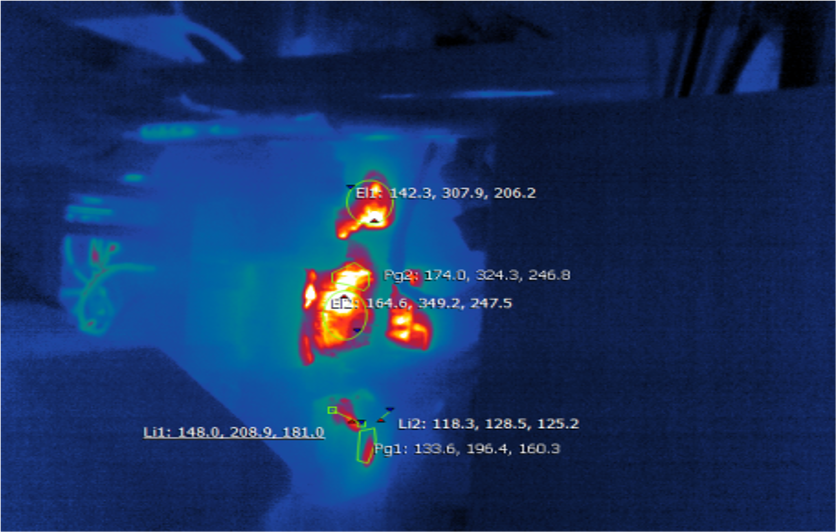
Traditional thermocouples provide only limited point-based measurements and cannot capture the complete thermal behavior of the die during production. Emitted Energy’s thermal imaging systems provide continuous, non-contact monitoring of the die surface, ejected castings, and surrounding process zones delivering full-field thermal visibility throughout every shot cycle.

By transforming temperature into real-time process data, manufacturers can identify thermal instability earlier, optimize spray and cooling performance, reduce scrap, improve tooling life, and maintain more consistent production conditions across the entire HPDC operation.
Why Thermal Imaging?

Contact thermocouples provide limited point-based measurements and often miss localized hot spots, cold zones, and cooling inconsistencies.

Infrared thermal imaging captures thousands of temperature data points simultaneously across the entire die surface, allowing engineers to:

Because the system is completely non-contact, there is:

Eliminate Defects & Ensure Bonding Excellence

Traditional adhesive processes leave room for variation and hidden flaws. Our infrared validation technology helps ensuring your bonds are strong, even, and reliable.

How Our Solution Solves These Traditional Issues:

Smart thermal data = smarter bonding decisions
Why Choose Us

We supply.
We support. We partner.

Thermal image of a high pressure die casting component showing localized hot spots and ROI temperature measurement zones used for thermal process monitoring and defect analysis.
Leading Companies Using Our Solutions
+
Part Inspection Without Destructive Testing
0 %
Months Average
Project Payback Period
<

At Emitted Energy, we bring over two decades of hands-on experience delivering precision thermal imaging and machine vision solutions to the manufacturing floor. Our team isn’t just fluent in sensors and software — we’re deeply rooted in industrial processes, with a proven track record of solving real-world challenges in metal casting, plastics, food production, battery assembly, and beyond. We understand the demands of high-throughput, high-risk environments, and we engineer systems that work reliably where others fail. From concept to commissioning, our experts partner with your team to design, deploy, and support thermal solutions that drive measurable improvements in quality, safety, and efficiency. When you choose Emitted Energy, you’re not just getting cutting-edge technology — you’re gaining a trusted partner who knows how to make it work in your world.

Trusted by Businesses Worldwide

Your Infrared Thermal Technologies Partner

We consider your project requirements and specifications, ensuring you find the right solution to deliver undeniable results. Schedule a meeting to discuss your application and let our experts tailor a solution for you today.

THE CHALLENGE

The HPDC Thermal Process Window

High pressure die casting operates within a narrow thermal process window where even minor temperature variation can create major production issues.

Hot Spots & Soldering

Localized overheating can cause aluminum to adhere to the die surface, damaging tooling and increasing maintenance requirements.

Cold Zones & Misruns

Insufficient die temperature leads to premature solidification, incomplete fills, and surface flow defects.

Thermal Fatigue Cracking

Repeated thermal cycling accelerates heat checking and die degradation, reducing tooling life over time.

Process Drift

Changes in cooling performance, spray coverage, or ambient conditions slowly shift thermal balance throughout production.

Without continuous thermal monitoring, these conditions often remain invisible until defects or downtime occur.

DIE SPRAY & THERMAL STABILITY

Die Spray is a Critical Process Variable

In high-pressure die casting, die spray plays a critical role in heat extraction, lubrication, part release, thermal balance, and tooling protection. Proper spray application helps maintain consistent die temperatures between shots while reducing soldering and excessive die wear.

However, inconsistent spray coverage, clogged nozzles, improper timing, or excessive lubricant application can quickly create thermal imbalance across the die surface.

These conditions may contribute to porosity, cold shuts, sticking parts, thermal fatigue, dimensional variation, and unstable cycle performance.

Because spray directly affects die surface temperature, thermal imaging provides a powerful method for validating spray performance in real time. By monitoring thermal response before and after spray cycles, manufacturers can identify inconsistent spray coverage, detect cooling irregularities, optimize spray timing, reduce lubricant consumption, and maintain stable thermal conditions throughout production.

In HPDC, spray is not simply maintenance, it is a measurable process variable that directly impacts casting quality and process stability.

CAMERA PROTECTION IN HPDC ENVIRONMENTS

Intrinsically Safe - Harsh environment with closure protects the camera lens

Designed for Harsh Die Casting Conditions

High-pressure die casting environments expose thermal imaging equipment to overspray, lubricant mist, debris, radiant heat, and contamination splash-back.

While the thermal camera is mounted outside the die area, spray and airborne contaminants can accumulate on the optical window and affect thermal measurement accuracy over time.

To protect imaging performance in these demanding environments, Emitted Energy offers industrial protective camera enclosures with automated shutter systems designed specifically for HPDC applications.

When integrated with the die casting machine and Emitted Energy’s Advisor™ Thermal Process Monitoring System (TPMS), the shutter automatically closes during the spray cycle to protect the optical window from overspray and contamination.

Once the spray cycle is complete, the shutter reopens for thermal data acquisition and process monitoring.

This synchronized protection system helps:

  • Maintain thermal measurement accuracy
  • Reduce lens contamination
  • Improve long-term reliability
  • Minimize maintenance requirements
  • Protect imaging equipment in harsh production environments

The result is stable, repeatable thermal monitoring performance throughout continuous HPDC operation.

OPERATIONAL IMPACT

ADVISOR System Enlighten Software thermal analysis

Measurable Return on Investment

Continuous thermal monitoring helps manufacturers reduce process variation and improve production stability across high-volume HPDC operations.

Typical customer benefits include:

  • Up to 40% reduction in thermal-related scrap
  • Improved die life through thermal balance control
  • Reduced porosity and soldering defects
  • Faster identification of cooling and spray issues
  • Reduced unplanned tooling downtime
  • Lower lubricant consumption through spray optimization
  • Full thermal traceability for quality documentation

For many facilities, the system delivers a rapid ROI through reduced scrap, extended tooling life, and improved production efficiency.

APPLICATIONS

Common HPDC Applications

Automotive Structural Components

Shock towers, subframes, battery enclosures, and cross members.

Powertrain & Drivetrain

Transmission cases, oil pans, valve bodies, and engine components.

Electronics & Telecom

Heat sinks, EMI shielding, LED housings, and thin-wall aluminum castings.

Industrial & Aerospace

Hydraulic manifolds, pneumatic housings, and structural castings require thermal traceability and process control.

Ready to Bring Thermal Visibility to Your HPDC Process?

Improve process stability, reduce scrap, optimize spray performance, and protect tooling investment with real-time thermal monitoring for high-pressure die casting.

Request a consultation to discuss your application and receive a tailored thermal imaging solution recommendation.

See the Difference with Our Thermal Imaging Technology

If metal stamping is a massive part of your manufacturing process, avoid product failure and increase your production rate and profit with reliable thermal imaging technology.