Application Snapshot
UDMAX GPA6-60 laminate crossply
target heating temperature
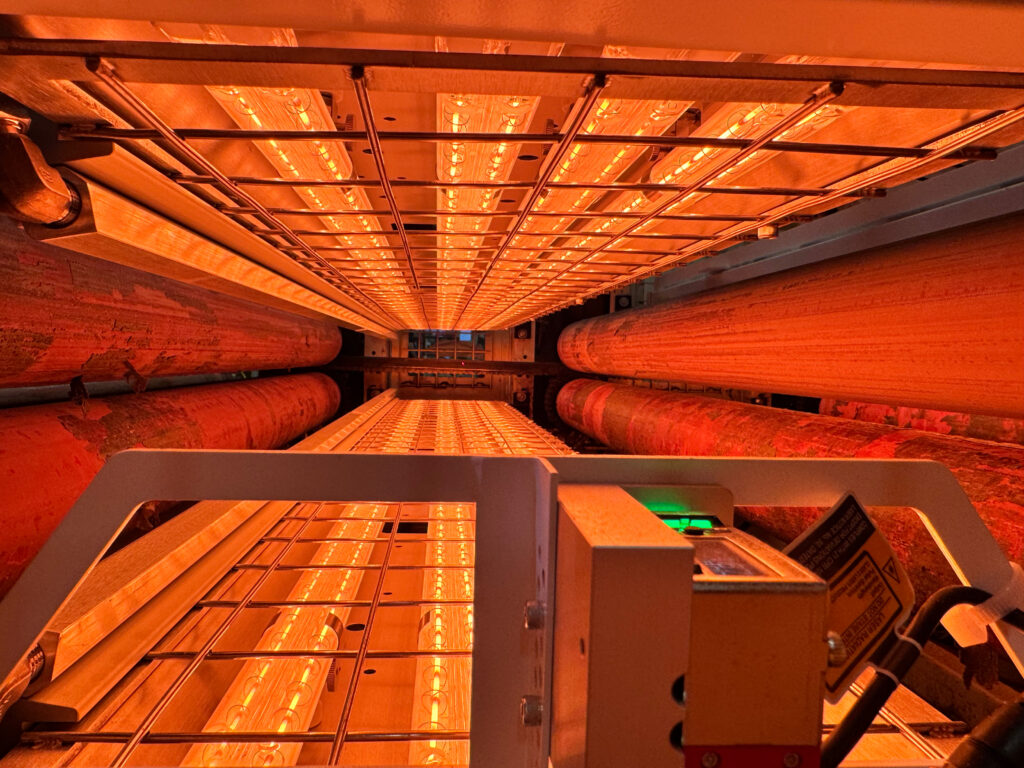
IR heater banks with pyrometer feedback
thermal quality gate before mold load
Composite insert heating must be fast, uniform, repeatable, and synchronized with robotic handling and molding cycle timing.
Emitted Energy combined two-sided IR heating, PLC-based power control, pyrometer feedback, and full-surface ADVISOR validation.
Application Challenge
An automotive manufacturing application required a reliable method to heat a pre-cut six-layer composite laminate crossply before a robot transferred the substrate into an injection molding process. The process needed to support high cycle repeatability while reducing the risk of non-uniform heating, rejected parts, and uncontrolled process variation.

Robot end-of-arm tooling presents the crossply vertically for heating, then moves the substrate downward through the oven into the mold.
- Pre-cut six-layer laminate crossply; approximately 9.6 mm nominal combined thickness.
- Target heating temperature around 270 deg C, with oven capability approaching 300 deg C.
- Part-to-part cycle context of roughly 78 seconds, with heating planned to overlap injection molding where practical.
- Uniformity and repeatability of surface temperature, with recipe development to evaluate through-thickness heat penetration.
Primary Risks Addressed
The proposed system is structured as three coordinated subsystems: the IR oven, the control cabinet, and the ADVISOR™ TPMS thermal process monitoring package. Together, they create a closed-loop heating cell with an independent thermal quality gate before mold loading.

Three Primary Systems
IR heater banks on both sides heat the substrate using a vertical pass-through process path.
SCR power control, recipe logic, safety interlocks, and pyrometer-based temperature feedback.
Thermal image capture after heating; pass/fail result, reporting, image archive, and MES/export support.
Decision logic: Validated substrates proceed to the injection molding tool; failed substrates can be routed to a reject table for review or scrap. The same data package can support trend reporting and quality records.
ADVISOR Thermal Process Monitoring
ADVISOR adds an independent, full-surface thermal validation step after heating. Instead of relying only on spot pyrometers or assumed oven performance, the system evaluates actual substrate temperature patterns before the robot commits the part to the mold.

What ADVISOR Contributes
ADVISOR adds an independent, full-surface thermal validation step after heating. Instead of relying only on spot pyrometers or assumed oven performance, the system evaluates actual substrate temperature patterns before the robot commits the part to the mold.
Thermal profile checked against recipe limits before robot load.
Thermal images, results, and temperature data can be stored or exported for quality records.
Thermal imaging evaluates temperature uniformity across the part, complementing spot feedback.
HMI display can show recent images, temperatures, and process status.
Common export methods can support plant quality and reporting systems.
Engineering and Delivery Approach
The project approach is designed to move from budgetary concept to engineered release while reducing uncertainty around heat recipe, mechanical integration, controls mapping, and acceptance testing.
Application review
Confirm part geometry, sample material, heating objective, robot path, and molding cell interface.
Engineering design
Produce formal CAD layout, mechanical drawings, controls architecture, signal map, and acceptance criteria.
Build and integration
Fabricate heater banks and control cabinet; configure pyrometers, SCR controls, HMI recipes, and ADVISOR software.
Tuning and FAT
Develop thermal recipe, validate uniformity window, debug pass/fail decision logic, and review data export.
Commissioning
Support mechanical installation, electrical integration, robot handoff, mold loading sequence, and operator training.
Customer-Ready Value
A coordinated IR oven and ADVISOR package helps manufacturers transform heating from a difficult-to-see process variable into a controlled, measured, and traceable production step.
Expected Operational Benefits
Closed-loop power control and recipe management support stable heat delivery across cycles.
Thermal images, temperature values, alarms, and decisions can be archived for continuous improvement.
The same design language can be adapted to other composite, plastic forming, adhesive, laminating, or joining processes.
Full-surface validation catches out-of-band substrates before value is added in the mold.
Operators and engineers can compare actual thermal patterns to recipe targets instead of diagnosing blind.
PLC/HMI architecture can be mapped to robot, molding machine, safety, and plant data requirements.
Make Heat Visible and Your Process More Predictable
Turn thermal behavior into actionable manufacturing intelligence with real-time monitoring, automated quality control, and complete process traceability. We’re transforming manufacturing through thermal intelligence.