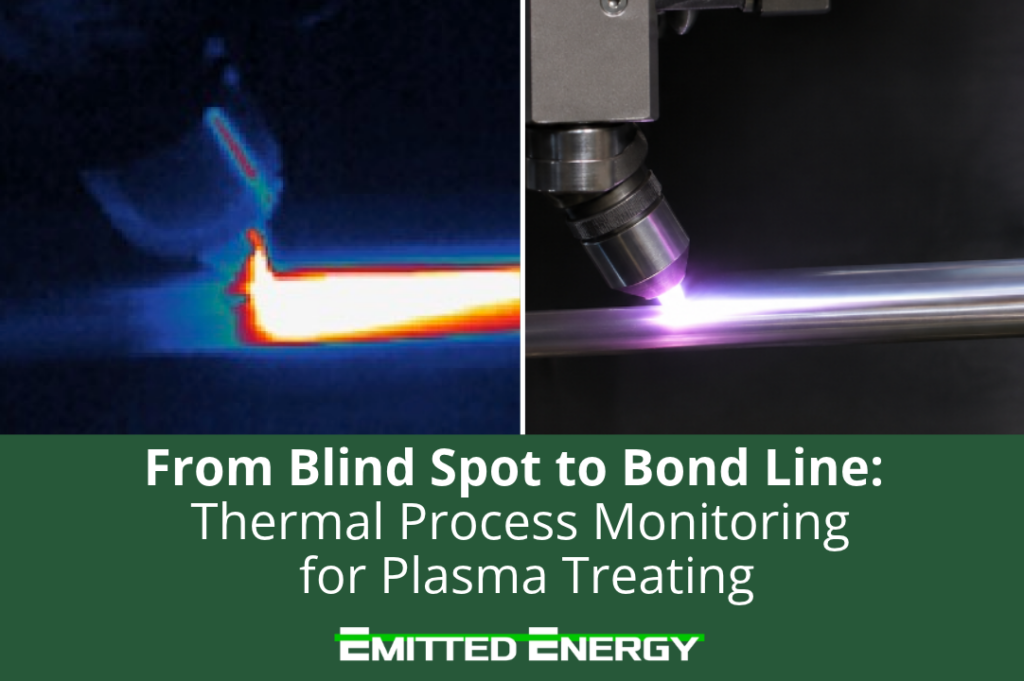
In every manufacturing operation, including atmospheric plasma treating, engineering and quality teams face a fundamental visibility gap: machine parameters tell you what the equipment was commanded to do; thermal imaging tells you what actually happened.
Atmospheric plasma treatment is widely used across automotive, medical device, electronics, and packaging lines to modify chemically inert, low-surface-energy polymers (such as PP, PE, and PTFE) before bonding, printing, or coating (Plasmatreat). Yet because both plasma energy transfer and the resulting surface modification are invisible to the naked eye, standard machine logs cannot confirm whether every square millimeter of a bond line received consistent energy, making true plasma surface activation monitoring impossible without advanced thermal sensors.
Three Critical Challenges: When Invisible Variables Threaten Plasma Treatment Quality
Atmospheric plasma modifies surfaces by introducing polar functional groups and micro-cleaning contaminants through ionized gas. However, research and plant-floor experience show that minor shifts in equipment output, robotics, or substrate condition significantly alter energy transfer and surface temperature without triggering a fault on standard machine controls (MDPI Polymers).
1. Process & Part Variables (Root Causes)
Equipment & Delivery Drift: Fluctuations in plasma power, gas or compressed air flow, and nozzle wear or contamination directly change plasma plume intensity and heat transfer at the substrate.
Kinematic & Geometric Variations: Subtle shifts in robot/path speed, nozzle-to-part stand-off distance, dwell time, part position within a fixture, or treatment overlap across complex 3D contours create uneven energy distribution. Peer-reviewed studies demonstrate that even small increases in plasma treatment nozzle distance or travel speed measurably reduce surface functional groups and alter substrate surface temperature (MDPI Polymers).
Substrate & Surface Inconsistencies: Incoming material and substrate variation (such as resin lot differences, additives, or moisture content) alongside residual surface contamination (such as mold-release agents or handling oils) alter how a part absorbs and responds to plasma energy.
The Dual Risk of Under-Treatment and Over-Treatment: Insufficient energy transfer leaves cold spots and under-treatment, while excessive dwell time, tight nozzle stand-off, or overlapping passes cause over-treatment, melting thin-walled polymers, inducing micro-warping, or thermally damaging sensitive micro-electronics.
2. Detection & Traceability Blind Spots (The Visibility Gap)
Delayed, Sample-Based Quality Testing: Offline dyne inks, contact-angle checks, and destructive pull tests inspect only a small fraction of output, often hours after thousands of parts have moved into bonding, curing, or final packaging.
Lack of Part-Level Traceability: Without inline plasma treatment inspection, standard PLC logs confirm only that power was supplied and valves opened. Without serialized part-level traceability, quality teams cannot prove that an individual assembly experienced proper thermal energy transfer along its entire bond path.
3. Downstream Quality & Business Consequences
Adhesion & Functional Failures: Undetected process drift leads directly to poor wettability, inconsistent adhesive bonding, delamination, coating or paint failures, and seal failures when products experience thermal cycling or mechanical stress in the field.
Operational & Financial Exposure: When suspect parts escape the plasma cell, plants absorb mounting scrap and rework costs, expensive lot containment actions, and long-term warranty exposure.
How Do Manufacturers Verify Plasma Treatment?
A common question from process and quality engineers is: "How do we verify that our plasma treatment actually worked?" Because no single measurement captures both chemical surface change and 100% inline production speed, leading manufacturers combine periodic surface validation with continuous plasma treatment process monitoring. Here’s a high-level view:
| Verification Method | What It Measures | Strengths | Limitations on the Production Line |
|---|---|---|---|
| Dyne Testing (Pens & Solutions) | Estimates surface energy (dynes/cm) via liquid wetting behavior. | Fast, low-cost shop-floor spot check. | Subjective pass/fail assessment, sample-based, and dyne inks contaminate the material, requiring parts to be discarded (Brighton Science). |
| Contact-Angle Measurement | Quantifies liquid droplet wetting angle on the substrate surface. | Objective, quantitative surface wettability data. | Typically offline or at-line; too slow for 100% high-speed inline inspection. |
| Adhesion / Pull & Peel Testing | Measures mechanical bond strength of the finished joint. | Direct proof of functional end-use bond performance. | Destructive, post-process, and performed hours after plasma treatment. |
| Machine Parameter Monitoring | Confirms generator power, gas flow, recipe selection, and robot path execution. | Essential baseline equipment health check. | Sees equipment commands, not physical energy transfer at the part. |
| Inline Thermal Process Monitoring ADVISOR™ | Captures the substrate’s real-time thermal signature across 100% of cycles. | Non-destructive, 100% inline inspection, part-level traceability, immediate anomaly alerts. | Measures thermal response rather than dyne level directly; requires baseline validation. |
How the ADVISOR™ Complements Existing Quality Methods
Infrared cameras do not directly measure chemical functionalization or dyne levels. Instead, plasma treatment thermal imaging bridges the gap between periodic lab checks and high-speed production through a four-step plasma treatment validation workflow:
1. Run a Known-Good Plasma Treatment
Engineering establishes target plasma parameters (power, gas flow, stand-off distance, and robot speed) on representative parts.
2. Validate with Your Established Quality Method
Quality confirms surface readiness and bond performance using dyne testing, contact-angle measurement, or destructive pull/peel testing.
3. Establish the Corresponding Thermal Signature
During system calibration, the ADVISOR™ captures the exact substrate thermal footprint produced by that validated treatment.
4. Continuously Monitor Production Against the Validated Process Window
The ADVISOR™ inspects 100% of production parts against that plasma treatment process window between periodic dyne or pull checks, reducing dependence on sample-based inspection while catching drift immediately.
The Golden Thermal Signature™ is A Smarter Standard for Plasma Process Control
Rather than simply asking, “Did the equipment finish its cycle?” the ADVISOR™ continuously asks: “Is today’s plasma treatment behaving like yesterday’s validated baseline?”
A Golden Thermal Signature represents the ideal, validated thermal fingerprint of your substrate during a perfectly controlled plasma treatment cycle. By anchoring inline plasma treatment quality control to a proven physical benchmark, engineering and operations teams gain better data for better decisions across every shift.

Three steps to establish the Golden Thermal Signature
| Step | Action | Description |
|---|---|---|
| Step 1 | Establish | Quality and engineering teams confirm a known-good plasma treatment using their established method (dyne testing, contact angle, or pull testing) and define optimal baseline specifications for each part family. |
| Step 2 | Integrate | The corresponding validated thermal profile is uploaded into the ADVISOR™ TPMS, powered by Enlighten™ software, to configure multi-point inspection zones and process thresholds. |
| Step 3 | Monitor | Real-time, 24/7/365 continuous tracking compares every production part against the established Golden Thermal Signature. |
By correlating external surface heat profiling and temperature distribution analysis with your established adhesion quality benchmarks, the ADVISOR™ system streams real-time data directly to your plant SCADA, MES, PLC, or operator dashboards and triggers instant alerts the moment a process deviation occurs.
Closing the Visibility Gap: What Plasma Equipment Knows vs. What ADVISOR™ Provides
The ADVISOR does not replace your plasma generator’s internal controls or robot controller. Rather, it adds an independent layer of process verification directly at the part.
| What the Plasma Equipment Knows | What ADVISOR™ TPMS Adds at the Substrate |
|---|---|
| The plasma generator fired at commanded power | Substrate Thermal Response: Confirms the thermal pattern delivered onto the substrate surface |
| Shielding or process gas flow was commanded | Plume & Delivery Consistency: Detects thermal anomalies potentially resulting from nozzle wear, contamination, or flow restrictions |
| The robot followed its programmed coordinates | Path, Speed & Stand-Off Verification: Reveals localized hot or cold deviations consistent with robot speed changes, fixture shifts, or nozzle distance drift |
| The correct recipe was selected | Substrate Response & Overlap Insight: Captures how incoming material variations or multi-pass treatment overlaps affect part temperature |
| The cycle timer completed | 100% Part-Level Pass/Fail Verification: Evaluates every unit against its Golden Thermal Signature before downstream assembly |
The Solution: The ADVISOR™ Thermal Process Monitoring System (TPMS)
Engineered-to-Order Solutions from Emitted Energy transform plasma treating from an unmonitored variable into a visible, measurable, and controllable operation. As FLIR® Platinum Partners, we integrate industrial-grade fixed-mount automation cameras capable of real-time radiometric analysis, machine-learning-assisted object detection and tracking, and continuous non-contact inspection at production line speeds.

The Plasma Treating Process with the ADVISOR™ Monitoring Loop
| Process | Description |
|---|---|
| ADVISOR System at Plasma Jet Exposure | Plasma plume interacts with the substrate surface under preset process parameters. |
| Calibrated FLIR® Infrared Hardware | Industrial radiometric cameras capture live thermal patterns and surface heat signatures across the bond path. |
| Enlighten™ Software Processing | Real-time heat profiling, visualization, and automated data logging compare live thermal behavior against baseline parameters. |
| Multi-Point Thermal Limits Analysis | Multi-point quality inspection zones evaluate temperature distributions and thermal deltas against the validated plasma treatment process window. |
| PLC / SCADA Alerts & Line Response | ADVISOR™ communicates pass/fail states, measurements, and alarms to the customer’s PLC or SCADA architecture. |
Clarifying Automated Line Response & Controls Integration
The ADVISOR™ communicates real-time measurements, thermal anomaly alarms, and pass/fail conditions directly to your cell PLC or plant SCADA system. From there, your existing controls architecture executes predetermined actions, such as stopping the line, diverting or quarantining a suspect part, alerting an operator, or initiating pre-engineered process adjustments. (Automated parameter adjustments are only executed when specifically engineered and validated into the customer’s controls application.)
Five Engineering & Operational Advantages of Thermal Monitoring in the Plasma Treating Process
- Integrating the ADVISOR™ system into your plasma treating line provides real-time process visibility, empowering your team to fix root causes, not symptoms and operate with confidence in every process.
- Proof-of-Concept Validation & System Calibration: During lab testing and commissioning, our engineers perform thermal characterization across your specific part geometries to establish multi-point inspection zones and validated thermal envelopes.
- Root-Cause Anomaly Detection: Rather than treating symptoms downstream, ADVISOR™ flags thermal patterns and deviations associated with nozzle wear, gas flow plasma treatment quality control to a proven physical benchmark, engineering and operations teams gain better data for better decisions across every shift.
- Scrap, Rework & Containment Reduction: Quarantining out-of-window parts at the plasma station prevents wasted adhesives, primers, coatings, and assembly labor on compromised substrates.
- Throughput Improvement & Scalable Process Control: Teams can optimize plasma treatment robot speed and cycle times with production confidence that every part remains inside its validated thermal window.
- Audit & Warranty Protection with Enlighten™ Data Retention: The Enlighten™ software automatically logs complete serialized records for every part, including:
- Timestamped CSV File Outputs: Min, max, and average temperatures, standard deviation, thermal delta, and pixel percentages per inspection zone.
- Radiometric JPEG Snapshots: Full-frame thermal images preserving pixel-by-pixel temperature data for post-process engineering review.
- CSQ Video Files: Continuous radiometric video recordings for frame-by-frame root-cause playback.
Improving Process Control Across Plasma Treating Applications
Because every application is unique, Emitted Energy’s ITC-certified thermal engineers design custom clear path solutions for unseen thermal challenges tailored to each facility’s tooling, line speed, and quality requirements:
Automotive & Transportation: Validates thermal consistency across polypropylene bumper fascias, composite body panels, instrument cluster displays, and EPDM weatherstripping prior to structural urethane bonding or painting.
Medical Devices: Provides serialized thermal traceability for catheters, microfluidic lab-on-a-chip assemblies, and syringe components requiring uniform hydrophilic coatings and leak-free ultrasonic or adhesive joints.
Electronics & Semiconductor Packaging: Monitors PCB de-smearing, lead-frame cleaning before wire bonding, and flip-chip underfill preparation, protecting heat-sensitive micro-circuitry from localized overexposure.
Consumer Products & High-Speed Packaging: Verifies consistent thermal profiles on carton flaps, bottle caps, polymer laminates, and cosmetic containers before high-speed adhesive sealing, pad printing, or UV-curable coating.
The ADVISOR™ Process for Insight and Improved Outcome in Plasma Treating
Emitted Energy delivers engineered-to-order solutions that provide real-time process visibility in plasma treating so manufacturing leaders improve consistency, reduce scrap, and operate with Confidence in Every Process.
| Process (What We Deliver) | Insight (What It Gives You) | Outcome (What That Means) |
|---|---|---|
| ADVISOR™ TPMS Powered by Enlighten™ Software | Real-time multi-point heat profiling compared continuously against each part’s validated Golden Thermal Signature | Catches under- and over-treatment at the station, preventing delamination, bond failures, and downstream scrap |
| Calibrated FLIR® Industrial Infrared Hardware | Non-contact thermal visibility into substrate energy transfer across complex 3D bond paths at line speed | Early detection of anomalies associated with nozzle wear, stand-off distance drift, robot speed variations, or gas flow shifts |
| Closed-Loop PLC / SCADA Integration & Serialized Logging | Instant pass/fail signals to customer controls plus timestamped CSV, radiometric JPEG, and CSQ video records | Automated part containment, reduced dependence on sample testing, and complete audit and warranty traceability |
By adding inline thermal process monitoring for plasma treating with the ADVISOR™ Thermal Process Monitoring System (TPMS), powered by Emitted Energy’s proprietary Enlighten™ software and calibrated FLIR® industrial infrared cameras, manufacturers gain real-time Thermal Process Intelligence. Converting heat into sight turns an invisible process variable into measurable, actionable production data, giving teams confidence in every process before suspect parts ever reach downstream assembly.
About Emitted Energy
Emitted Energy equips manufacturers with engineered thermal process monitoring solutions that make heat visible, measurable, and controllable.
From injection molding and plastics joining to die casting, forging, aerospace, food processing, and industrial automation, the ADVISOR™ Thermal Process Monitoring System delivers real-time thermal intelligence that improves quality, increases throughput, reduces scrap, and enables predictive manufacturing.
Our customers use ADVISOR™ TPMS to reduce quality spills, improve first-pass yield, accelerate process development, optimize cycle times, and create complete thermal traceability. Whether the challenge is hidden voids, short shots, cooling imbalance, or process drift, the ADVISOR™ transforms thermal behavior into actionable manufacturing intelligence.
Machine parameters tell you what the equipment was commanded to do. Thermal imaging tells you what actually happened.
Emitted Energy ADVISOR™ Thermal Process Monitoring System and thermography services are transforming manufacturing processes: Making Thermal Behavior Visible. Actionable. Controllable.
CALL TO ACTION: Talk with an Emitted Energy Certified Thermal Engineer
1. Book a Call with a Certified Thermal Engineer. Every application is unique. We listen for root causes to plan, build, test, and commission with accuracy and expediency.
2. Review the Design and Timeline to meet your validation requirements and production schedule.
3. Experience Thermal Intelligence at Installation with an in-house-engineered, pre-tested system that provides insight and validation with seamless integration.
Think Thermal. Perform Better. The Thermal Edge.
Frequently Asked Questions (FAQs)
1. Why isn’t standard machine data enough to verify plasma treatment consistency?
Machine parameters only confirm what your equipment was commanded to do, such as generator power, gas flow rates, or programmed robot speed. They cannot confirm what actually occurred at the substrate surface. Once a known-good treatment is validated with your established quality method and paired with its Golden Thermal Signature, the ADVISOR™ TPMS continuously monitors the actual thermal pattern across the bond line, detecting deviations consistent with nozzle wear, stand-off distance drift, or speed changes before suspect parts move downstream.
2. Does thermal imaging directly measure dyne level or plasma treatment surface energy?
No. Infrared cameras measure thermal energy transfer and surface temperature distribution rather than chemical functionalization or dyne levels directly. Instead, during proof-of-concept validation, engineers correlate a dyne- or pull-tested known-good treatment with its corresponding Golden Thermal Signature. The ADVISOR™ then monitors 100% of production parts against that validated thermal process window between periodic surface checks.
3. How does inline thermal monitoring work alongside destructive dyne or pull testing?
Dyne pens, contact-angle meters, and destructive pull tests provide essential chemical and mechanical validation, but they are sample-based and often performed well after parts have left the plasma cell. Inline thermal monitoring provides 100% non-destructive inspection between periodic validation checks. This reduces dependence on manual sampling and enables immediate containment when thermal behavior drifts out of window.
4. Can the ADVISOR™ detect both under-treatment and substrate overheating to prevent plasma treatment adhesion failure?
ADVISOR™ can identify thermal conditions associated with under-treatment or excessive thermal exposure once those conditions have been established during process validation.
5. How does the ADVISOR™ integrate with our existing robots, PLCs, and SCADA systems?
Emitted Energy delivers engineered-to-order systems pre-tested in our lab prior to installation. On the line, the ADVISOR™ communicates pass/fail signals, zone measurements, and thermal alarms directly to your cell PLC or SCADA network so your controls architecture can quarantine suspect parts, alert operators, or halt production automatically.
6. What data does Enlighten™ software record for quality audits and traceability?
For every inspected part, Enlighten™ logs timestamped CSV metrics (min/max/average temperature, standard deviation, thermal delta, and pixel percentages), full-data radiometric JPEG snapshots, and CSQ thermal video files. With this data, your quality teams have complete serialized traceability for customer audits and warranty defense.