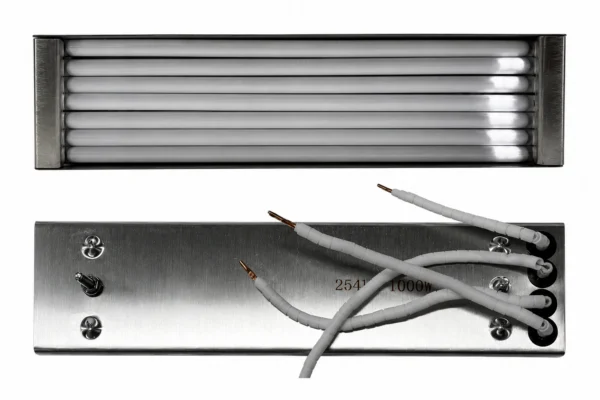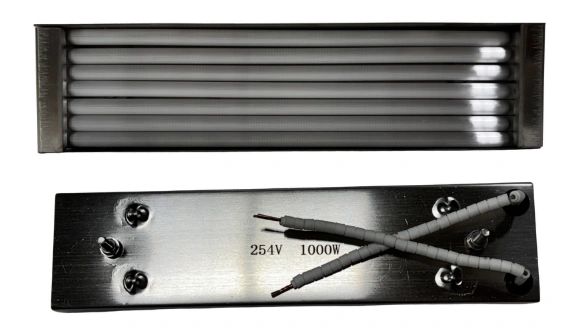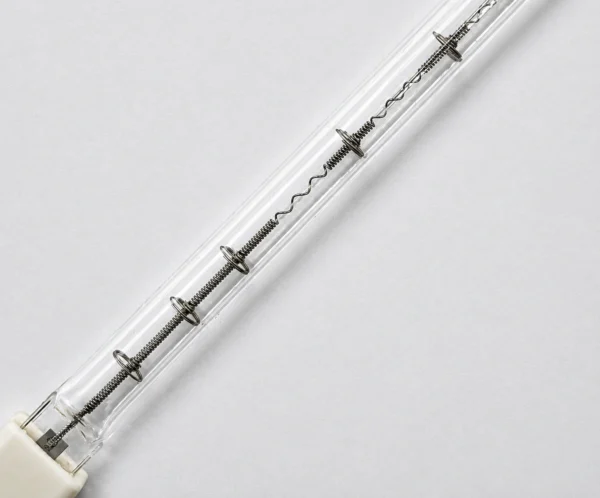
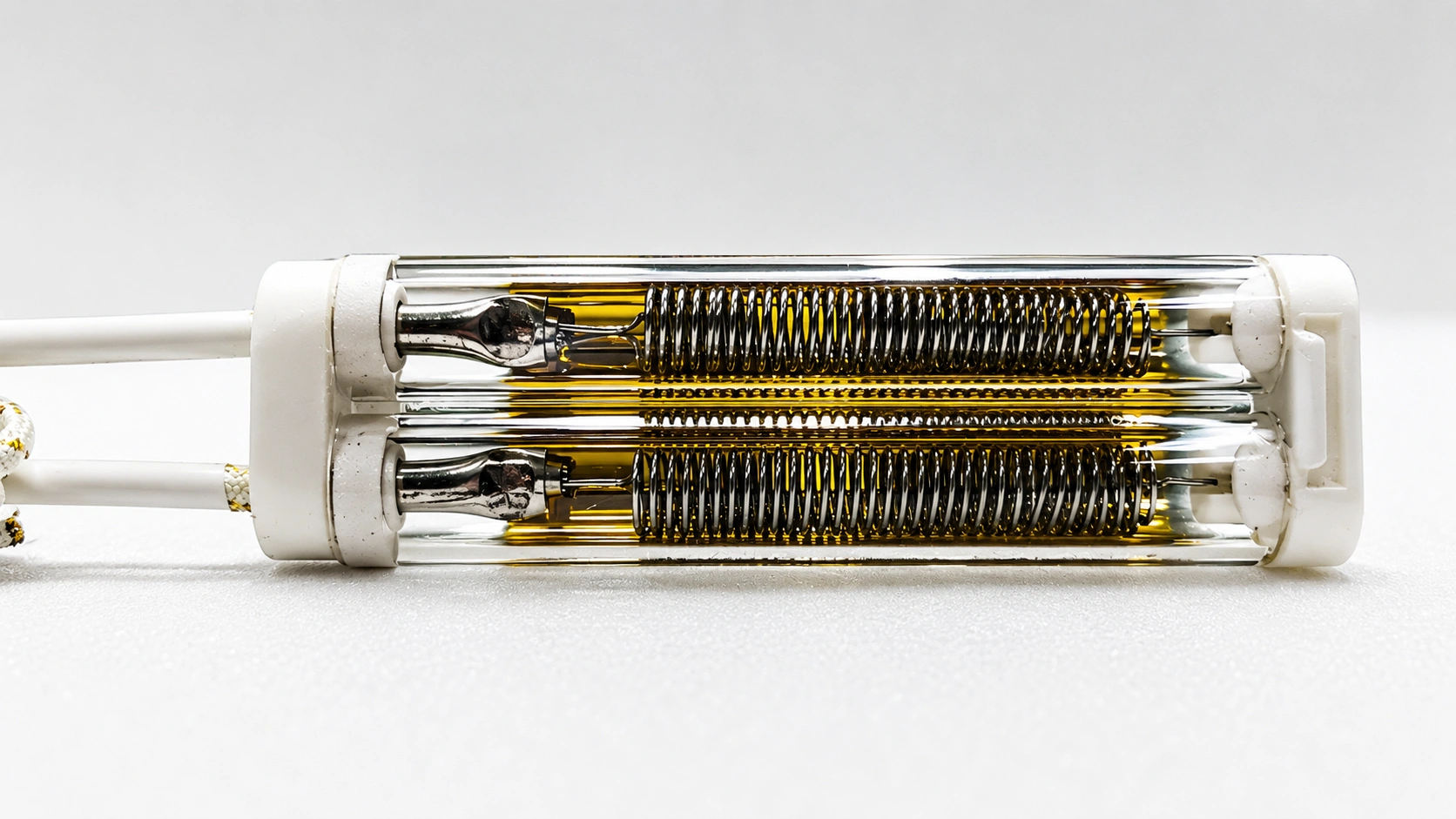


Twin-tube infrared quartz emitters deliver high power density radiant heating in a compact footprint. The H-iron twin tube design increases watts per linear inch, improves structural strength, and supports longer heating spans than single-tube emitters. Available in short wave, tungsten medium wave, carbon medium wave, and NiCr medium wave configurations for industrial drying, curing, thermoforming, coating, and process heating applications.
Twin-tube infrared quartz emitters deliver high-power industrial heating in a compact footprint. In addition, the H-iron twin-tube design increases strength, supports longer heating spans, and provides higher watts per linear inch than standard single-tube emitters.
As a result, the twin-tube profile improves heat focus and overall system stability across wide heating zones. Because of this, manufacturers commonly use twin-tube emitters in drying, curing, thermoforming, laminating, coating, printing, textile production, and industrial oven systems.
Furthermore, Emitted Energy manufactures twin-tube infrared quartz emitters across four emitter categories. Each category offers different wavelength ranges, response times, and heat output levels to match specific process needs.
| Type | Short-Wave | Tungsten-Based Fast-Response Medium-Wave | Carbon-Based Fast-Response Medium-Wave | Medium-Wave (NiCr) |
|---|---|---|---|---|
| Filament Material | Tungsten | Tungsten | Carbon Wound | Nickel-Chromium (NiCr) |
| Filament Temperature | 1,800–2,400°C | 1,400–1,800°C | ~1,200°C | 800–950°C |
| Peak Wavelength | 1.0–1.4 µm | 1.4–1.6 µm | ~2.0 µm | 2.0–4.0 µm |
| Response Time | ~1 second | 1–2 seconds | 1.5–3 seconds | 1 minute+ |
| Guaranteed Life | 5,000 hours | 5,000 hours | 4,000 hours | 10,000 hours |
| Max Watts / Linear Inch | 200 W/in. | 120 W/in. | 200 W/in. | 50 W/in. |
| Key Advantages | Intense short-wave radiation for deep penetration and rapid heat-up. | Combines short-wave intensity with broader wavelength absorption. | Broad spectral output for coatings, adhesives, and difficult materials. | Long service life with stable and uniform heat output. |
| Common Applications | Automotive paint curing, glass tempering, carbon fiber processing, and high-speed printing. | Offset printing, digital dryers, polymers, coatings, and composite processing. | Specialty coating lines, lamination systems, adhesives, and industrial drying. | Thermoforming, shrink packaging, textile drying, and large-format lamination. |
Besides emitter wavelength and filament type, reflector coatings also affect heating performance. Different reflector options change how heat moves to the material surface. As a result, the right reflector can improve efficiency, heat control, and process stability. In addition, selecting the proper reflector coating helps optimize infrared heating for specific industrial applications.
White reflector coatings provide broad and even heat distribution for general industrial heating applications. In addition, they perform well in continuous-duty systems where stable heat patterns are important.
Gold reflector coatings reflect up to 95% of infrared energy back toward the material surface. Because of this, gold coatings improve energy efficiency, reduce rearward heat loss, and support focused high-speed heating applications.
Red reflector coatings help manage radiant heat distribution and support controlled thermal performance in specialty heating processes. In many applications, they provide balanced heat transfer and stable operating conditions.
The best reflector coating depends on:
Because every heating process is different, Emitted Energy works directly with customers to select the reflector coating that best matches the application.